- Length
- 15 cm
- Weight
- 20 g
Presence in the Strait
Occasional. Nine records, all in October except two: at Gibraltar on 28.03.67 and 5.04.67.
Identification
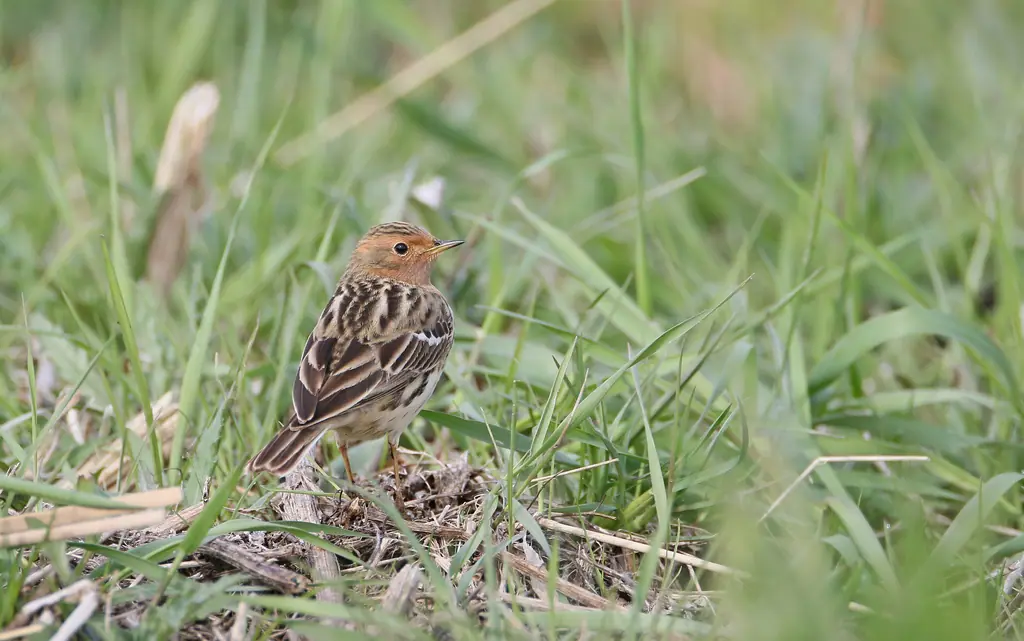
Juveniles are similar to a Meadow Pipit with distinct pale tertial edges, black and white mantle stripes, streaked rump, stronger contrasting supercilium and more extensively streaked breast and flanks. In winter, adults have pinkish throat. Its call is similar to that of a Tree Pipit but higher and more drawn out. It breeds in the Arctic and Subarctic; Eastern migration, wintering in Africa. Motacillidae Bisbita Alpino ad.E ad.W Bisbita Costero Bisbita de Richard ad.E juv. Bisbita Gorgirrojo Lavandera Boyera Motacilla flava / Yellow Wagtail En Europa existen ocho subespecies, de las que se han visto cuatro en el área del Estrecho. En todos los casos varía el diseño en la cabeza de los machos. There are eight sup-species in Europe, of which four have been seen in the Strait. The head pattern of males varies in all cases. Motacilla flava iberiae L 17 / P 18 Estatus: Estival común de zonas húmedas y campiña. Se distribuye por la Península Ibérica y el sur de Francia. Identificación: Macho con partes inferiores amarillas intensas y manto verde grisáceo; lista superciliar y garganta blancas, aurículas oscuras y píleo gris; patas negras y cola larga. Hembras con partes inferiores más pálidas. Jóvenes con partes inferiores amarillas ante, partes superiores marrones oliváceas, lista superciliar con margen oscuro, lista malar marrón oscura y una franja de pintas oscuras en el cuello. Movimientos: Máximos en 2ª q. marzo y 2ª q. septiembre.
Movements
Peaks in 2nd hf. March and 2nd hf. September. R: France (2), and one bird born in the Marismas del Palmones ringed on 26.05.91 controlled 168 days later, on 10.11.91, in Senegal, 2,442 Km. away. Motacilla flava flava Con garganta amarilla y aurículas grises claras, se observa durante los pasos migratorios. Proviene del sur de Escandinavia y Europa Continental. R: Alemania (12), Bélgica (6), Suecia (3), Suiza (3) y Holanda (1). With yellow throat and pale grey ear coverts, is seen during migration. It breeds in the S of Scandinavia and Continental Europe. R: Germany (12), Belgium (6), Sweden (3), Switzerland (3) and Holland (1). Motacilla flava flavissima Con píleo y aurículas amarillo verdoso y lista superciliar amarilla, se observa durante los pasos migratorios. Proviene de Reino Unido. R: Reino Unido (4). With yellow-green crown and ear coverts and yellow supercilium, is seen during migration. It breeds in the United Kingdom. R: United Kingdom (4). Motacilla flava feldegg Con frente, píleo, nuca y aurículas negras. Accidental, una cita de un macho en plumaje nupcial el 26.04.93 en el bosque de la finca Guadacorte. De conducta muy confiada; utiliza árboles como posaderos. Proviene de los Balcanes y Mar Negro. With black forehead, crown, nape and ear coverts. Accidental, one record of a male bird in breeding plumage on 26.04.93 in the forest of Finca Guadacorte. Very confident behaviour; uses trees to perch. It breeds in the Balkans and the Black Sea.
Ring recoveries
Francia (2), y un ave nacida en las Marismas del Palmones anillada el 26.05.91 y recapturada 168 días después, el 10.11.91, en Senegal a 2.442 Km. Status: Common summer visitor to wetlands and countryside. Its distribution includes the Iberian Peninsula and the S of France. Identification: Males have intense yellow underparts and grey-green mantle, white supercilium and throat, dark ear coverts and grey crown, black legs and a long tail. Females have paler underparts. Juveniles have buff-white underparts and olive-brown upperparts, supercilium with dark border, dark malar stripe and brown necklace.
Bioestrecho editorial text. Last revised: 8 September 2026.
Gallery
Karim Haddad, CC BY · 2020
Karim Haddad, CC BY · 2020
雲一百香果, CC BY · 2026
Katerina Kalogerini, CC BY · 2025
Christoph Moning, CC BY · 2021
Christoph Moning, CC BY · 2021